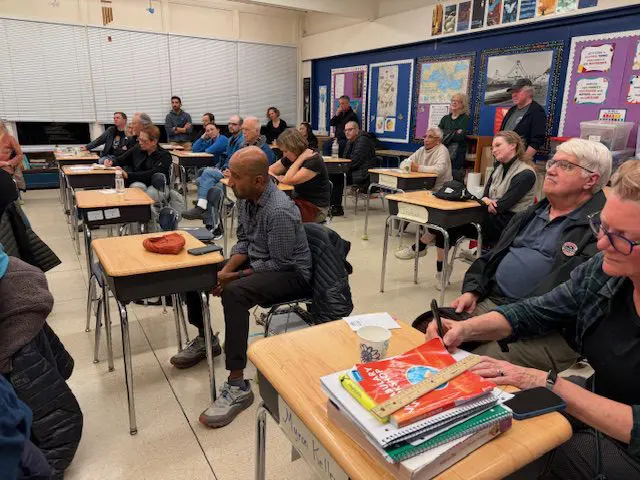
Thank you to everyone who joined the Glen Park Association for our 2026 Winter Quarterly Meeting last night. It was a great turnout!
Admin Stuff
1. New GPA Board voted in
Check out the new crew on our Contacts page
2. Bylaws amended
Check out the new wording on Article III, Section 302 (B) in the Bylaws
3. See upcoming events on our sidebar
City Attorney David Chiu
 Now in his fifth year as the elected City Attorney, David Chiu gave us a rundown on his office. San Francisco’s elected City Attorney handles civil (not criminal!) matters, defending the city from lawsuits and bringing legal actions on its behalf.
There are about 300 staffers on 30 teams codifying legislation dreamed up by the Board of Supervisors, investigating public integrity issues, looking into building code enforcement, affordable housing fraud, illegal nightclubs, and illegal construction.
For example, his public integrity team has proved dozens of contractors misused public dollars, forbidding those folks from applying for City contracts and suing them for damages.
Recently the office sued or shut down nine corner liquor stores in the Tenderloin that were found to be involved with the street drug trade.
Lately the office has spent a lot of time wrestling with the federal government. During the first Trump administration, Chiu’s predecessor brought 10 lawsuits against the administration over 4 years. In this first year of the second Trump administration, Chiu has brought 14 lawsuits covering a wide spectrum of litigation involving healthcare, housing, public safety, and federal dollars owed to San Francisco. So far they have won 11 of 12 lawsuits that have been decided.
Q&A
Q: Is the city going to take over power service from PG&E?
A: PG&E is not maintaining power lines and the electrical grid in a way that is best serving SF. The City wants to take over aspects of the electrical grid and provide power. This is something that is done to the parts of the state successfully, and the City successfully runs other utilities (SFPUC, for example).
Unfortunately, to do this we need to acquire the physical assets of PG&E: poles, wires and substations. We offered about $2.5 billion, but PG&E has refused. We are currently in an oppositional proceeding for us to obtain these assets essentially through eminent domain. Ultimately, the California Public Utilities Commission will decide the case.
 Q: How are you protecting the City’s immigrants from the federal government?
A: We have advised our clients, including the police department and the sheriff’s department, on what we should be doing in different scenarios. We are monitoring what’s happening in Minneapolis and Minnesota, which is unconstitutional, and thinking about what might we have to do if something like that happened in San Francisco.
We are a sanctuary city because we believe these laws keep residents safer: immigrants who need not fear deportation from local law enforcement are more likely to report crime and cooperate with investigations. Studies show sanctuary cities are no less safe – and in some ways are safer – than cities without those policies.
Q: Can your office help stop the woman feeding pigeons literal tons of birdseed in our neighborhood?
A (from D8 SFPD liaison Dave Burke): We are drafting an education campaign to alert people to the public health hazards of feeding the birds. The police have to catch her in the act of feeding the birds to cite her, and in the past she has just paid the tickets and continued to feed the birds. If you see her feeding the birds, report it to the SFPD non-emergency number: 415- 553-0123.
A (from City Atty Chiu) The law did not anticipate this kind of behavior, and what’s more is the challenge with the criminal justice system. As a former prosecutor, I can tell you, it’s hard to go in front of a jury and say, ladies and gentlemen, send her to jail.
Q: Why not increase the penalty?
A: The laws have to be written to be generally applicable, so if you’re going to increase this penalty, penalties for similar activities also increase. In the last 10 years, there’s been a push not to increase penalties, since they affect lower income people the most. (Exception to this has been around retail theft)
Q: How are you advising Supervisors with regard to the AT&T cell phone tower proposed for Diamond Hights?
A: Everything depends on the facts and the law. Supervisors might be reflecting on whether they have the grounds to vote against something, given the legal requirements and factors that they’re allowed to consider.
If AT&T sues the City for not allowing the tower, my job is to defend the City’s decision. AT&T and its fellow utilities in Sacramento have a lot of sway over where they can site their utilities because the public demands the services.
Q: What’s happening with the Parks Alliance?
A: Our office, along with the City Controller, is in an ongoing investigation of what happened there.
Contact Chiu’s office by emailing cityattorney@sfcityatty.org
District Supervisor Rafael Mandelman
 The Supervisor has one year left in office and is gratified by the improved cooperation among City Hall officials. He and the Mayor are working on charter reforms to simplify the City’s governing laws (the City Charter) that would go before the voters this November.
Budget negotiations will be starting soon, and the City will need to cut more once again. That’s always hard because there isn’t a lot of fat to trim. The City just announced $17 million in public health cuts from the last year’s budget, including cuts to HIV prevention services.
The Supervisor continues to focus on behavioral health issues. We need the state to get back in the business of guaranteeing a floor around mental health for Californians, but until then, we have local initiatives.
Recently he and the mayor announced that state funds have added 50 locked subacute treatment beds at SF General. Those beds go to people who are in the earlier stages of conservatorship but don’t need acute hospital care. Laws around conservatorship probably need to change, but the real barrier to conserving more people is that we don’t have enough of the right kinds of beds and staff.
Assemblywoman Catherine Stefani is promoting Mandelman’s legislation to allow for a court to order involuntary treatment of a person in outpatient treatment. These are people not yet conserved but who are spiraling out of control. They could be forced to take a monthly anti-psychotic shot, for example, which is more easily managed than daily medication. It will be hard to get this through the Legislature, and it is opposed by civil liberties groups.
Mandelman hosts office hours open to the public twice a month, usually once in a cafe and once on Zoom. Schedule a visit by emailing mandelmanstaff@sfgov.org
Q: Thank you for getting lights in Glen Park’s commercial district repaired!
Q: Why does SF spend so much more per citizen than other municipalities?
A: We are a city and a county, so we have the city functions and the county functions in our $16 billion budget. For example, we run the airport; we spend a lot of money on a large nursing home for indigent people in SF; we have one of the best public health hospitals (SF General), but that costs a lot of money. Then there is also the high cost of living in SF, requiring highly paid city staff if we want to attract and retain an excellent workforce.
Also, SF politics range from center left to far left. We don’t have a strong political constituency advocating for reduced taxes and reduced spending. I think there’s some benefit in having that voice kind of pulling in the other direction.
I think there is an analogy in the criminal justice context. San Franciscans are pissed off about crime, but then you put San Franciscans on juries, and it’s hard to get a conviction out of them. Residents are upset about waste and would like to see a more business-friendly city that is more attractive for job creation where costs are not as high, yet we always vote to increase taxes.
Q: There have been so many ballot initiatives that earmark funds for certain priorities, which makes the budget really inflexible. Is fixing that in scope of the charter reform?
A: It is in scope for the conversation. I don’t know if it’s going to be in scope for what we’re able to do in the relatively short period of time. Set-asides are difficult because they often fund important priorities: we have great libraries, great parks thanks to set-asides.
But as different groups see other groups getting their set aside, then they feel like, oh man, we gotta get in there. So, 20 years ago, 15% of the city’s discretionary budget was accounted for through set-asides. Today, it is north of 30%.
I can think of things that I have not seen a set-aside for that I think are fundamentally important to our future as a city. Why don’t we have an infrastructure set aside? Given that we need to build housing, given that we need transportation and all sorts of infrastructure to support the housing we’re committed to building, shouldn’t we be investing in the infrastructure to make this work?
If we did that, then we wouldn’t be having to push as much of the infrastructure development onto private developers as we currently do. We hear from developers this is a major reason they do not move forward with projects.
So, I think we’re going to try to tackle it, but the trouble is, each of these set-asides passes with the voters, and if we put, like, some global reform to it that, like, takes the 33% and, say, makes it 15% again, but that will require cuts to popular programs.
Q: There is a dangerous branch about to fall from a Monterey Cypress tree on Diamond Heights Boulevard. We have called it in to 311, but it’s still there.
A: Getting multiple reports from multiple people about this kind of issue helps. Be descriptive in your reports.
Contact Rafael Mandelman’s office by emailing mandelmanstaff@sfgov.org