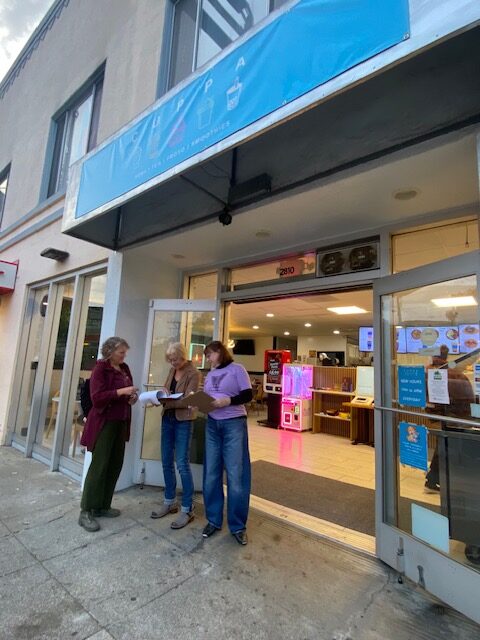
Thanks to everyone who attended the fall quarterly meeting Oct 20, and thanks to Abdul at Cuppa (and the GPA) for the free froyo! Turns out the promise of gummy bear-topped yogurt makes for great socializing.
We started with upcoming dates (see GPA sidebar for the latest) and updates on work done by neighborhood partners:
- You’ll remember that the GPA received a $25k grant from Avenue Greenlight to put the “slow” into the Arlington Slow Street. The money would pay for murals and planters where state law now forbids parking. SFMTA is drawing the dimensions of what can be painted, and artist Dahlia Gustafson—who grew up on Arlington—will incorporate neighborhood feedback into her design for the corners. Learn more here.
- The GPA wrote a letter in support of Bernal Cut Project’s proposal for an Islais Creek Watershed Storytelling Project mural on the I-280 freeway underpass. The educational mural will complement the two murals proposed for the other side of the underpass.
- Finally, Glen Park Beautiful, which also received a grant from Avenue Greenlight, has grand plans for downtown Glen Park, including a mural for the fence on the patio next to Pono and a refreshed “welcome to Glen Park” sign. Keep an eye on the GPA sidebar for events.
Then we turned toward disaster, a topic inspired by the many stories about a wet winter on its way.
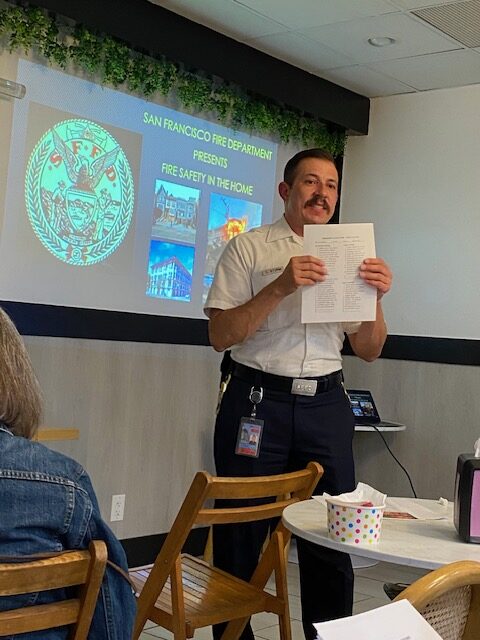
Fire in Glen Canyon
The risk of a catastrophic fire in Glen Canyon is low, thanks to fog, but not zero, thanks to the highly ignitable invasive blue gum eucalyptus trees. SF Fire Department Inspector Calder Storm cited a civil grand jury report released in June that found fire abatement coordination among the four city entities responsible for distinct portions of the Canyon to be lacking. (The Glen Park News wrote about SF PUC’s work to reduce that risk here.)
Storm said the Fire Department has purchased all-terrain vehicles with special hoses and equipment (mini pumpers) to fight wildland fires. Every firefighter in SFFD has had training to respond to an incident like a fire in the Canyon, and some have extra training. Battalions 6 and 9, which encompass 10 stations, have created a plan to protect the homes bordering the Canyon and train regularly in the Canyon, he said.
Lithium Battery Fires
Inside the home, Storm cited the dangers of lithium battery fires. While rare, these fires burn quickly and are difficult to extinguish. He suggested charging cell phones, e-bikes and other lithium batteries during the day, then unplugging them at night. And for sure don’t plug them next to your only exit in a fire.
 Overwhelmed by Disaster Prep?
 Overwhelmed by Disaster Prep?
It was easy to feel like a person could never prepare enough, but some steps are simple.
The first is easy: sign up for AlertSF notifications, said Jackie Thornhill, spokeswoman for the Department of Emergency Management. Text your zip code to 888-777 or sign up at alertsf.org, and you will receive rare but important texts about things like storms and traffic fiascos, as well as instructions when needed.
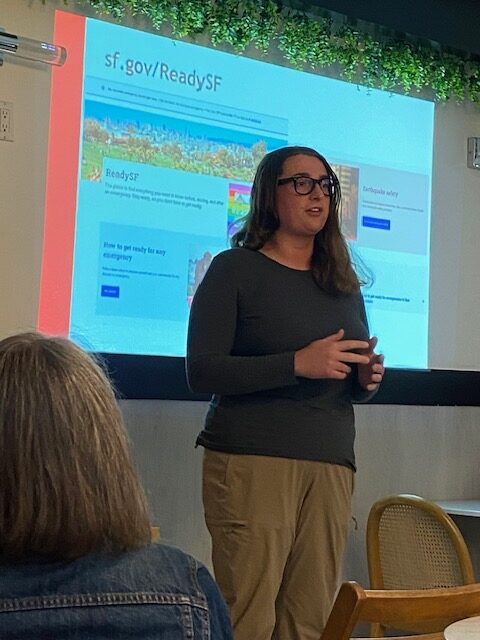
The second is almost as easy: designate an out-of-area contact, someone whose cell phone reception won’t be snarled when the disaster strikes. Preferably someone more 200 miles away, said emergency preparedness specialist Jeff Morelli, who led disaster training for the Oakland Fire Department for many years. He now works as a private consultant and specializes in training groups of neighbors.
Third can also be done over a beer tonight: have a disaster plan. Where will we meet if we’re not together during the disaster? Where is the backup place to meet if our house collapses?
Fourth, know how to turn off your water and gas. Every utility has its own tool, Morelli said. He keeps an adjustable wrench on hand. What’s more, the fixtures are often painted over or rusted or obstructed in some other way that could really hamper your ability to mitigate danger, so assess your situation before disaster strikes. (Note that if you turn off your gas, only your utility can turn it back on.)
Now it gets harder: water, food and supplies. Assume you’ll be without water and power services for two weeks, said Morelli. In a huge catastrophe, it could take first responders a full week just to even understand the extent of what they need to prioritize, let alone tend to a non-emergency.

You’ll want two gallons of water per day per person for two weeks (“You want to wash your face, don’t you? And what about pets?” Morelli asked the stunned crowd.)
Some of that can be found in your water heater, so long as it is bolted to the wall. (Unbolted, it could topple and break a gas line.) Some of it could be stored in BPA-free containers like these, but you’ll want to add water preservative. Without it, water should be refilled every six months; with it, every five years. Tape the fill date to the container.
Yep, overwhelmed
ReadySF has a complete list of necessities. I’ll just list tidbits I heard while my head was buried in the sand:
Food in the fridge will last 24 to 48 hours, depending on how much you open and close the door. Eat that first, then dig into the freezer.
Tune into KGO AM740. The radio station has its own generator and can operate when others go dark, it has a strong signal over a wide area. Best to do that on a crank radio that doesn’t rely on battery.
Don’t hang art over your bed (“Caravaggio Kills Couple in Quake!”); Secure your bookshelves (“Bradbury Brains Couple in Quake!”); put child latches on your cabinets (“Wedgewood Vase Wallops Couple in Quake!”)
Put a whistle near where you sleep (a person yelling can be heard 200 feet away, a whistle can be heard 2 blocks away)
Keep extra medication in a go-bag. Medicine bottles are a good source of information for your medical needs because they have your doctor’s name and the details about your prescriptions.
Ideally, you’ll have a go-bag of supplies in your car and a stay-box of supplies in your house. Download detailed lists from the city’s ReadySF page.
Have cash in small denominations. Your Apple Pay won’t work after the Big One, at least not for a while.
Have extra keys, extra shoes, where’s that flashlight??
Easiest of all?
One important element of preparedness is to know your neighbors – who has mobility challenges, who has Starlink?
Thanks to numerous block parties and neighborhood meetings, there are many blocks within Glen Park where neighbors know each other well, and Thornhill congratulated the crowd for socializing over froyo before the meeting began.

GPA member Haley Raquer ended the meeting by talking about NERT. Neighborhood Emergency Response Training is a six-week course that prepares citizens to help first responders in the event of an emergency. The four-hour sessions were a big commitment, she said, but the training was fun and full of great information.
She’s interested in creating a shorter training, and we will let you know what gets developed.
Her pre-storm list is here:
- Have roof checked for leaks and gutters cleared
- Have arborists take care of any trees hanging over structures/powerlines
- Clean out drains (street and property)
- Apply any non-slip measures to stairs/walkways
The city also has an Adopt A Drain program, enabling residents to head off flooding disaster.
The GPA board will discuss strengthening community perhaps through group trainings and perhaps by always having social time before the meeting, though that would mean fewer speakers. Let us know what you think and want to see by emailing us at info@glenparkassociation.org
To be honest, less information might have been welcomed Tuesday night, as we rolled out of Cuppa toward home to unplug our battery-powered devices.