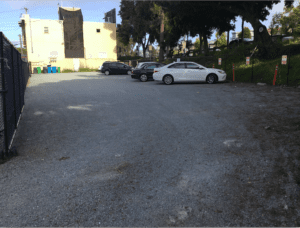
The gravel parking lot on Kern Street in downtown Glen Park could become the site of eight four-story townhouse apartments as envisioned in a feasability study submitted to the San Francisco Planning Department.
 The initial study is dated March 19, 2026 and was submitted for a project review meeting, which allows a developer to get Planning Department feedback in advance of submitting a final proposal.
It shows a line of eight townhomes, each with a family-friendly three-bedroom layout that also includes an office and a small private outdoor space. The ground floor of each townhouse can either be constructed with a garage plus storage or with an Accessory Dwelling Unit (i.e., a small studio apartment.)
The parking lot would be divided into eight individual parcels, so that each townhome would stand on its own land.
The address is given as 51 Brompton, although the bulk of the parcel runs along Kern Street.

The project was first noted by SFYimby.com, which is a real estate and development news site based in New York City. It is not connected with SFYimby.org, which is a pro-housing non-profit and a chapter of YIMBY Action, a national network of people who advocate for abundant, affordable housing across the United States.
The land is owned by the Hayes family. They confirmed to the Glen Park News that they are exploring possibilities for the parking lot with the San Francisco Planning Department. The family also owns several other buildings in Glen Park including the Pono Boutique at 2860 Diamond Street and the building that houses Gialina Pizzeria, Sol Gym and La Corneta Taqueria, none of which are included in the townhome proposal.
Couldn’t have been built two years ago
The projects stands out for several reasons. It appears to be the first several-unit housing proposal in more than 20 years in Glen Park. It is for individual townhomes rather than condos or apartments. And perhaps most newsworthy of all, it might actually get built.
In a city where opposition by neighbors has scuttled innumerable proposed buildings, this design can be approved “ministerially,” meaning it is not subject to public hearings.
The project takes advantage of Senate Bill 684, which became law on July 1, 2024. The bill streamlined the approval process for small-lot housing developments in California and allows a larger lot to be subdivided into ten or fewer units.
Under the bill, each unit may have no more than one parking space per unit, and no space is required if the lot is located within a half-mile walk of a major transit stop or high-quality transit corridor – which this block definitely is.
Most important, if a project meets all the requirements of the law, it cannot be delayed by public hearings or discretionary reviews.
The four-story proposal is actually smaller than what could potentially be built on the site. Under the City’s new Family Zoning rules, housing built on the site could be as tall as six to eight stories because it is so close to a major public transit hub.
The proposed plan seems “awfully reasonable,” noted District 8 Supervisor Rafael Mandelman, currently the president of the Board of Supervisors. “It’s way less intensive than they could do.”
A good place to add housing
The 51 Brompton site is perfect for more housing because of how close it is to BART, to shops and to a public elementary school, said Hillary Schiraldi, zoning chair for the Glen Park Association and its vice president.
“This is a great place for new homes. I know plenty of people who would love to live in a new construction townhouse kitty-corner from BART.”
She believes that having more families and more neighbors is good for our merchants. The fact that the units are “family-sized” with three bedrooms rather than just one or two is “nice” she said.
“My kid attends the school across the street [Glen Park Elementary.] More kids for that school is great. Glen Park is a great place to live and I would love to welcome new neighbors.”
A similar-sized project is now beloved
In terms of size, the development would be in line with the complex that houses Canyon Market, the Glen Park branch of the public library and 15 condominiums. That 4-story building was completed in 2006 – though only after bitter controversy in the community as a small but vocal minority decried its size and density and used the City’s notoriously complex planning requirements to stymie it for years.
Allison Arieff, a Glen Park resident who helped found the architectural magazine Dwell and has written about urban planning and design for more than 25 years, remembers the disagreements well.
“People got so upset about the Canyon Market building. I distinctly remember someone making a reference to Nazi Germany in a hearing about that project,” she told the Glen Park News.
Twenty years later, the contentious project did not destroy Glen Park, notes Arieff, who is now a columnist with the San Francisco Chronicle.
“Today, it’s transformed the neighborhood and is a focal point,” she said. “The library is completely bustling all day, people are always shopping at Canyon Market. It’s become the center of the neighborhood.”
To her mind, the project seems “the highest and best use of the for an underutilized and underused parking lot.”
This type of small project is exactly what is needed if San Francisco is to build new housing to accommodate those who want to live here. Large projects require large lots, which are in short supply in the City, she said.
“But the City does have a ton of lots like this, which are small, kind of awkward and underutilized. This is a perfect example,” she said. “It’s a mix of units, it’s got ground floor access, it’s in a walking area and it’s quite respectful of the scale of the neighborhood.”
Historic Glen Park
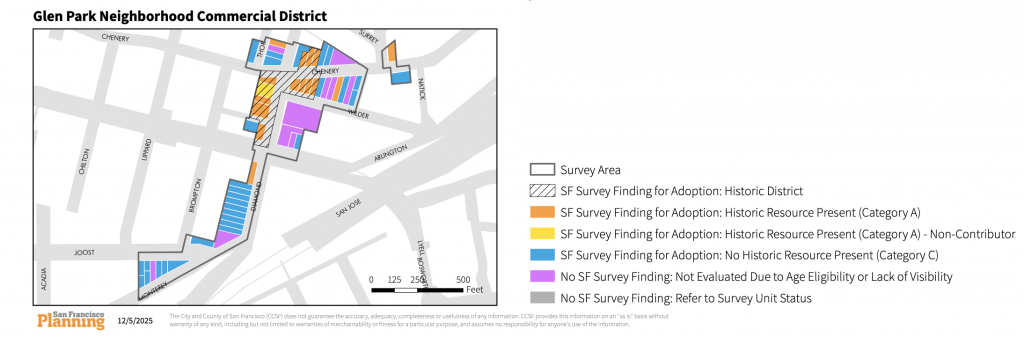
Much of downtown Glen Park around the parking lot was recently designated a historic district, with 15 buildings determined to be historic resources. According to Planning Department literature, a historic designation requires that “any new development respects and integrates a property’s historic character-defining features.”